2,4 glasses of wine. Zero Hindsight. And an aircraft carrier.
In 2011, somewhere between misplaced confidence and very favorable Latvian tax assumptions, I founded my first company.
Around that same time, a close friend and I left a music festival convinced we had a bigger idea.
We needed scale.
We needed atmosphere.
We needed a venue that felt impossible.
On paper, it sounded magnificent. The idea was to import and export beverages between the Baltics and South Africa. One of those ventures that looks brilliant in a late-night conversation and receives precisely zero serious scrutiny before someone decides it is destiny.
We needed scale.
We needed atmosphere.
We needed a venue that felt impossible.
That’s how we found Spilve Airfield in Riga.
That… enormous piece of infrastructure, heavy with sunk cost and historical inertia, large enough to host the kind of crowd we imagined. Looking back, I barely cared about the music festival itself.
What interested me was something else entirely: What can you do with an airport for a fixed period of time?
How do you maximize a dormant asset?
How do you force utility out of forgotten infrastructure?
How do you turn idle space into economic and cultural velocity?
Surprise: The festival never happened.
We visited the site a few more times, took long walks through a place built for movement that no longer moved, and eventually the whole thing died the way many first ventures do: not with catastrophe, but with a shrug.
And yet, this failed project mattered more than many successful ones that came later.
Latvia taught me something I didn’t yet have the language for:
I care more about the infrastructure layer than the final service or product.
More than the party, I cared about the venue.
More than the business, I cared about the system.
More than the headline, I cared about the machinery underneath.
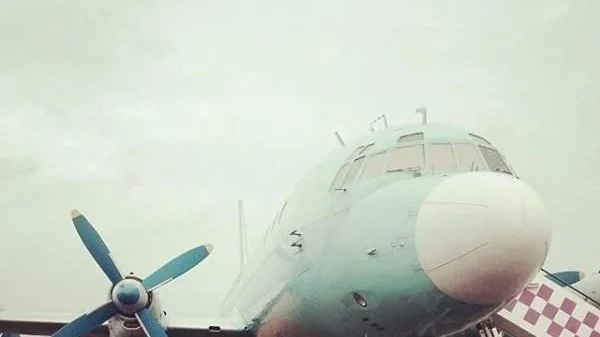
Rave on a Plane.
That knack has followed me ever since.
Networks. Conflict. Capital. Culture. Systems that outlive the people using them.
The lesson was brutal and useful:
Good ideas die in the trenches of reality.
Vision without insight is just theatre and money alone rarely closes a durable deal.
We were young, loud, foreign to the administrative rhythm of post-Soviet day-to-day, and far too convinced that enthusiasm could substitute for alignment.
It can’t.
But failure leaves sediment.
Reading through the original REVOLVE plan now is almost embarrassingly revealing. On one page alone we had already mapped a progression from a 3,500-ticket launch at Spilve to ambitions of 40,000 to 50,000 tickets per session, followed by international expansion into Brazil, Hong Kong, New Zealand, South Africa, and, for reasons that still make me laugh, Tahiti.
And then there it was in black and white, the sentence that probably explains far too much about how I still think today:
“To top it off we have an incredible concept involving an aircraft carrier.” (Referring to USS intrepid)
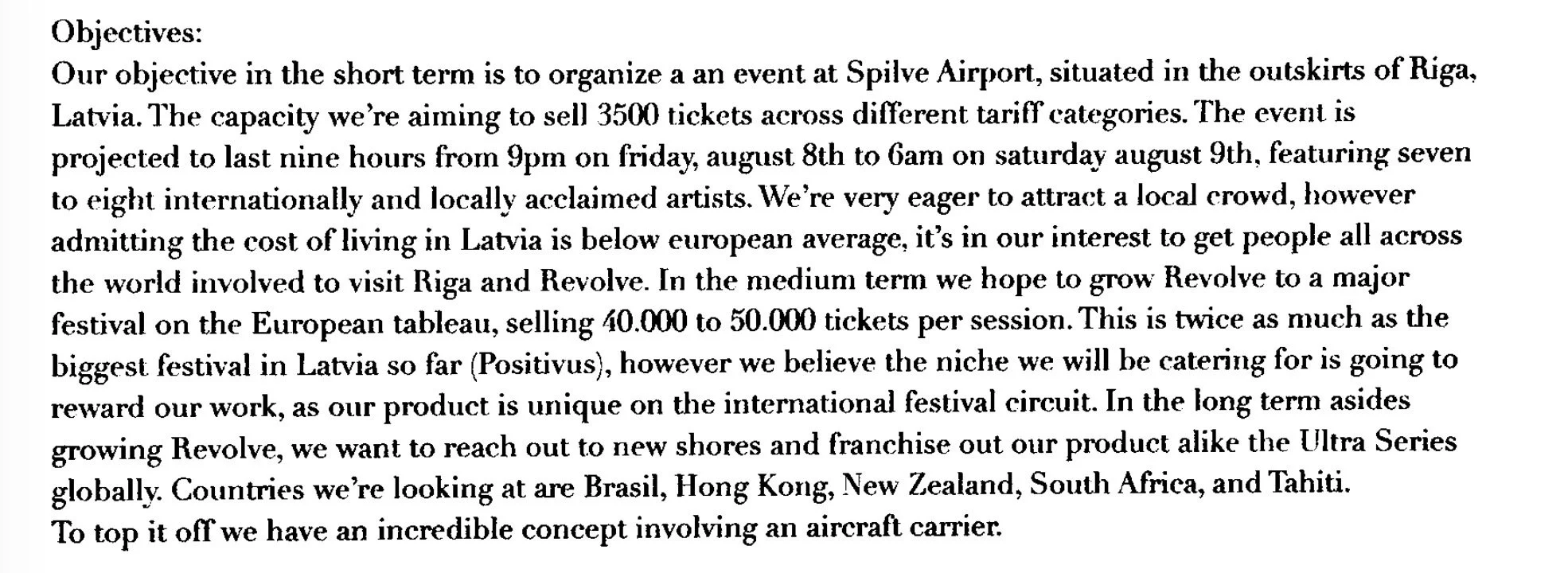
Screen grab from Archive Scan of original Business Plan (2013)
THAT was the tell.
Even before a single event had taken place, the instinct was never local, never singular, never merely about one night in Riga. The mind had already moved to systems, scale, replication, and infrastructure as a platform.
Ten years later, you often realize the path began far earlier than you thought.
Sometimes with a failed company.
weirdly regularly with an abandoned airfield.
Sometimes with 2.4 glasses of wine in a club at 3 a.m.
#DX_Treatment